01 / HTTP 200
Successful checkout
Follow the recorded reservation, payment, shipping and notification calls.
Follow the happy path →Turn C/C++ crashes into source-verified execution-flow reports. Follow recorded calls across services, inspect the fault location, and see what evidence is missing.
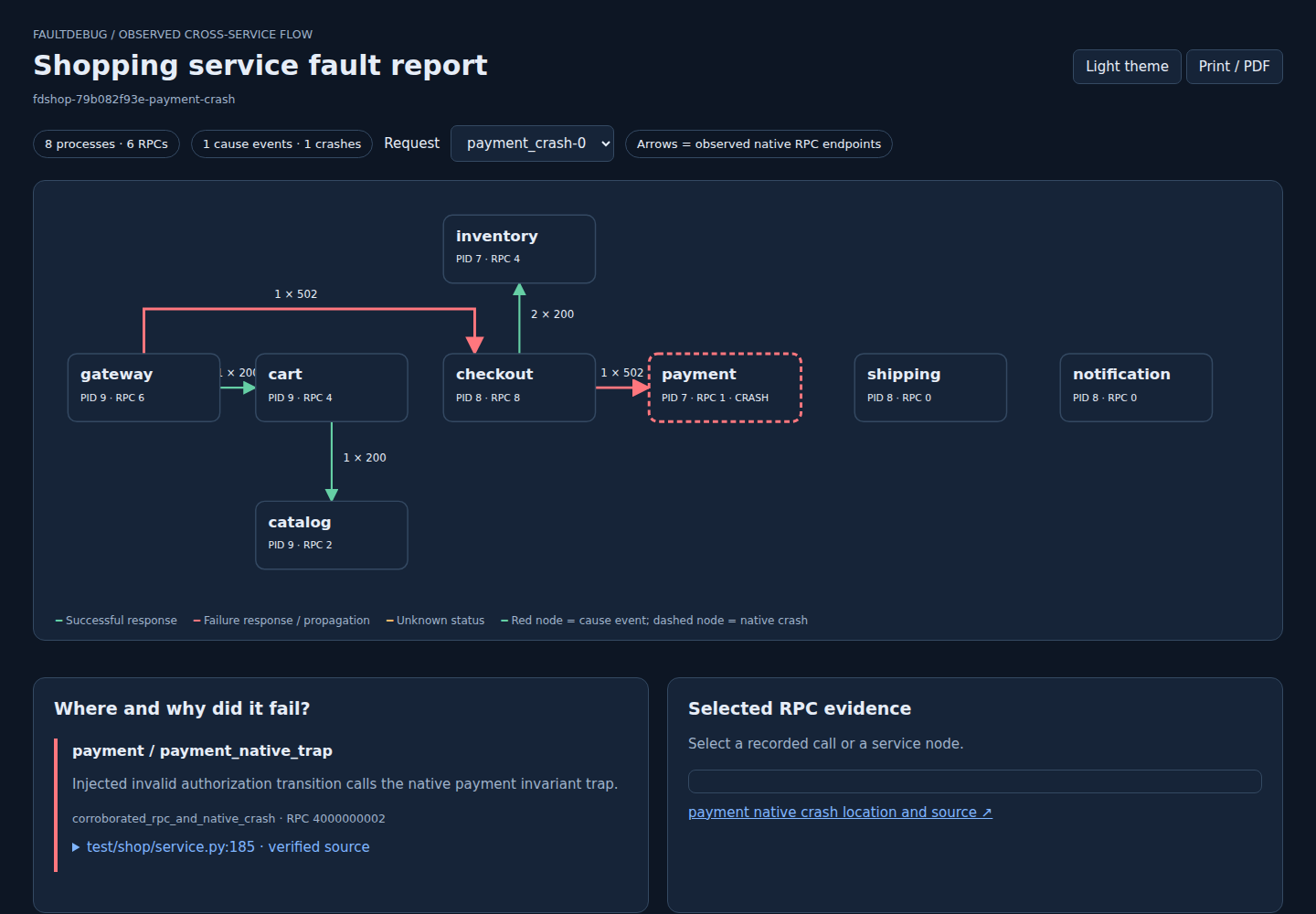
Choose a case, then select a service or RPC to inspect its evidence.
Follow the recorded reservation, payment, shipping and notification calls.
Follow the happy path →See the missing receiver end, caller failure and native crash linked to verified source.
Find the crash evidence →Compare caller timeout and receiver observations without treating the injection setting as proof.
Inspect the timeout →Also explore a real native C SIGSEGV capture → · Download native evidence
A short walkthrough of the actual interactive report: service flow, selected RPC, and source-verified native crash.
Linux x86_64 + local Docker Engine and Compose. The script downloads a checksummed prebuilt image, runs 8 services and opens a local report server. No host Python, Clang or CMake installation.
git clone https://github.com/lsh235/FaultDebugMCP.git
cd FaultDebugMCP
./scripts/try-demo.shThe runner uses your local Docker socket to create and remove its own fixture containers. Ctrl+C stops the report server. Existing output directories are never overwritten.
The shopping app is Python with an instrumented C++ boundary. These are native boundary events, not Python stacks. A stable snapshot can still be incomplete; the payment crash keeps that limitation visible.
Try a report, tell us what was unclear, or contribute a small improvement. If FaultDebug is useful to you, star the repository to follow its progress.